


IAMMETER App Store Officially Launched
IAMMETER App Store Officially Launched
IAMMETER users often want monitoring tools that are more focused than a standard dashboard.
For example:
- a local dashboard with faster real-time updates;
- a simplified display for a workshop or control room;
- a tool for testing IAMMETER meter APIs;
- a monitoring page with a custom layout, company name, or logo.
The IAMMETER App Store helps turn these ideas into reusable applications.
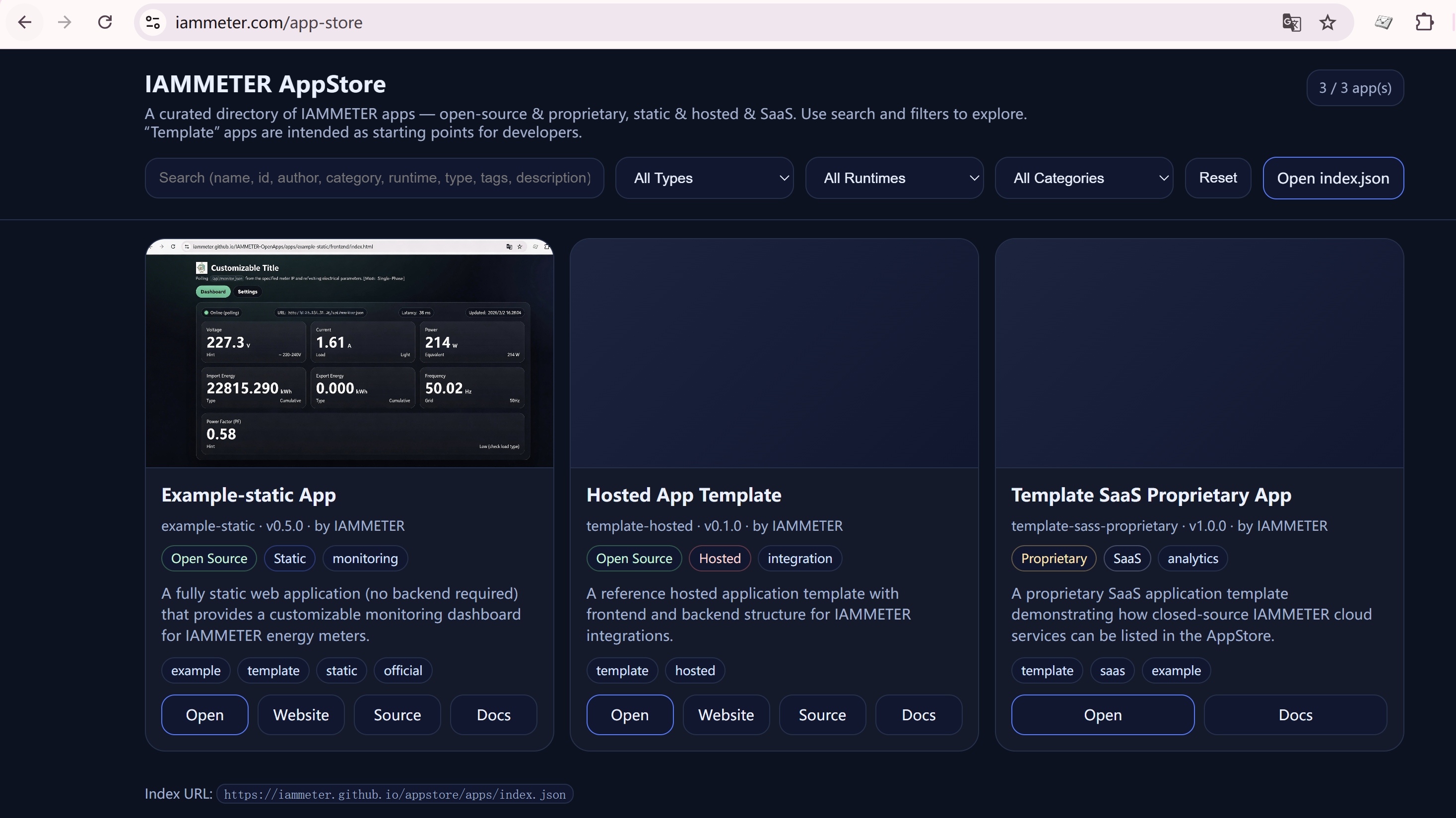
It is an open application ecosystem focused mainly on projects built with IAMMETER meter Local APIs. IAMMETER engineers and community developers maintain the ecosystem together, with a strong emphasis on applications whose source code can be inspected, reused, and improved.
Build Your Own Energy Dashboard in 5 Minutes
Build Applications with IAMMETER Local APIs
IAMMETER meters provide Local APIs that return real-time electrical measurements such as voltage, current, power, and energy.
IAMMETER meters support CORS on their local HTTP APIs. This allows a pure frontend application built with HTML, CSS, and JavaScript to communicate directly with a meter when the browser and meter are on the same local network.
An application built this way can:
- read data directly from the meter without first uploading it to IAMMETER Cloud;
- run without its own backend server;
- be hosted on GitHub Pages or downloaded and used locally;
- provide a customized dashboard, visualization, or diagnostic tool;
- serve as an open-source starting point for further development.
This architecture lowers the development barrier and makes it practical to turn a focused monitoring idea into a working application quickly.
Explore Open-Source Apps and Tools
The IAMMETER App Store brings these projects into one catalog.
Current examples include:
- local meter monitoring dashboards;
- an IAMMETER Local API Explorer;
- API testing and diagnostic tools;
- static application examples that developers can modify.
Each App Store entry can provide an application link, documentation, source code, version information, and project details. Users can also like, favorite, or comment on applications.
The App Store focuses mainly on open-source projects. This helps users understand how an application works, adapt it to their own requirements, and contribute improvements back to the ecosystem.
Developer Participation and Reward Points
IAMMETER welcomes developers to build and submit applications based on IAMMETER Local APIs.
Developers may use traditional development workflows or modern AI-assisted coding tools to create dashboards, utilities, examples, and other practical applications.
High-quality App Store contributions can earn Reward Points (RP), recognizing the work involved in development, testing, documentation, and ongoing improvement.
The goal is to make useful applications available to more IAMMETER users while giving developers a practical reason to share their work.
Cloud Apps and App Store Serve Different Purposes
IAMMETER also provides Cloud Apps, but Cloud Apps and the App Store have different roles:
- Cloud Apps are built with the IAMMETER Cloud API, maintained by IAMMETER, and used to explore and supplement IAMMETER Cloud features such as monitoring, reports, and billing tools.
- App Store applications are built mainly with IAMMETER meter Local APIs and are maintained jointly by IAMMETER and community developers, with a focus on open-source projects.
For a detailed comparison, see IAMMETER Cloud Apps vs. App Store: What's the Difference?.
Our Vision: Make IAMMETER Application Development Accessible
Our goal is to make IAMMETER application development accessible to both experienced developers and users who are new to programming.
The App Store's static application model, open Local APIs, reusable examples, and AI-assisted development tools make it possible to:
- start from an existing project;
- describe a monitoring requirement;
- modify the interface and logic;
- test the result directly with an IAMMETER meter;
- share the finished application with other users.
IAMMETER will continue improving Local API documentation, examples, and development guidance so that more users can turn practical ideas into reusable applications.