


Why Do IAMMETER and Utility Meter Data Differ? A Real Case Study Analysis
---
abstract: Why IAMMETER and utility meter data may differ in solar systems, explained through a real-world case study.
estimated_reading_time: 6 minutes
language: en
author: Miwyf
---
Why Do IAMMETER and Utility Meter Data Differ? A Real Case Study Analysis
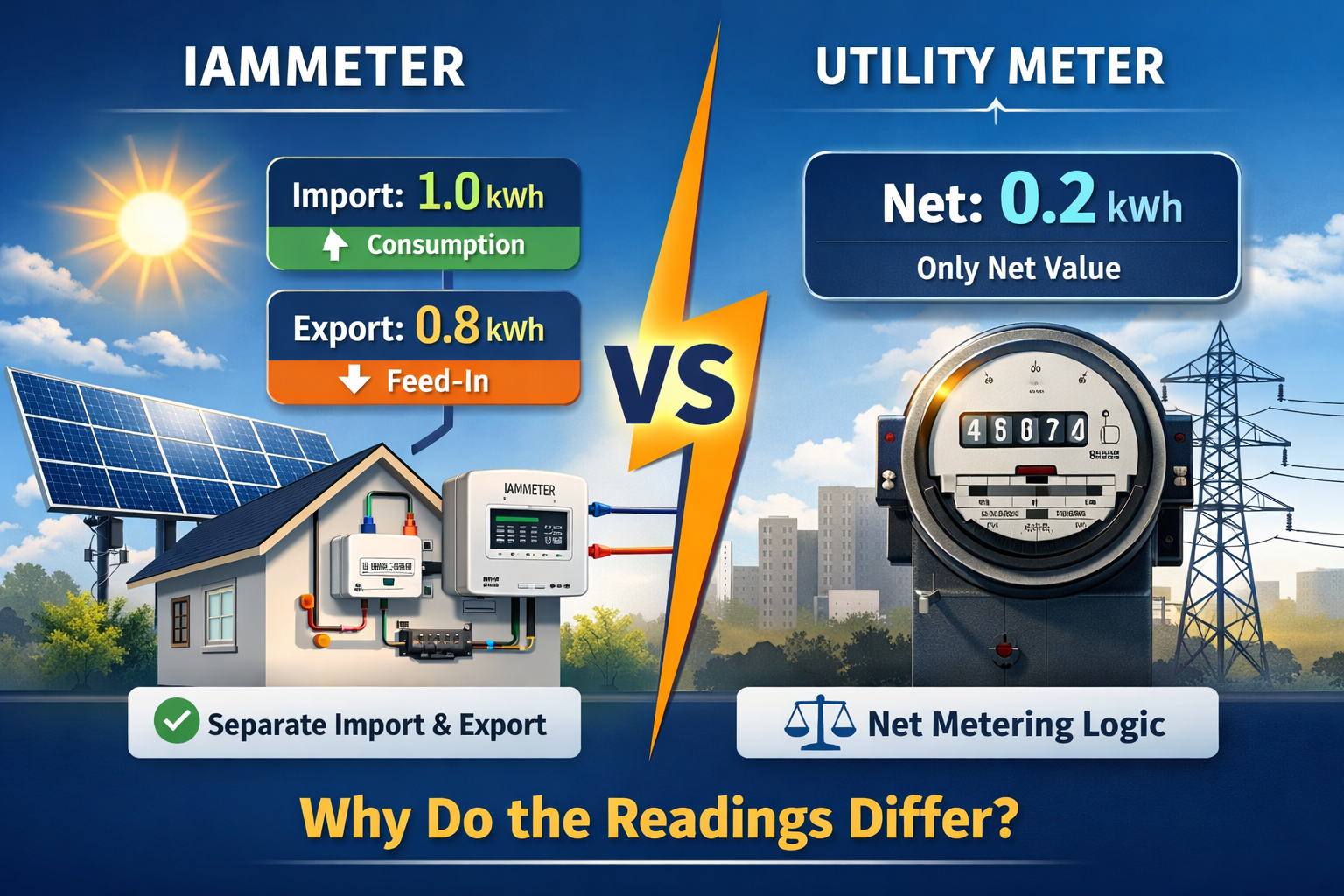
In real-world applications, we received feedback from a user in Spain:
After installing an IAMMETER energy meter, the data differed significantly from the utility company's records. The user suspected that the meter might be unstable.
This is a typical but important issue worth analyzing in depth. In this article, we walk through a real case, explain the root cause, and clarify the misunderstanding.
If you are new to IAMMETER, you can first read this overview: 👉 /blog/what-is-iammeter
1. Problem Description
The user installed an IAMMETER meter in January 2026 and observed the following:
Monthly comparison
| Period | Result |
|---|---|
| January | Data closely matched the utility meter |
| February | Significant differences on many days |
| March | Mostly consistent, except for one day |
Due to large discrepancies in February, the user suspected:
⚠️ The IAMMETER meter might have stability or accuracy issues.
2. Data Sources
To investigate the issue, we requested raw data from the user:
Both datasets included:
- Import energy (consumption)
- Export energy (feed-in)
3. Initial Finding: The Difference Is Real
After comparing the two datasets:
❗ We confirmed that significant discrepancies did exist on multiple days in February.
4. Key Discovery: Differences Occur Within the Same Hour
👉 All large discrepancies share the same characteristic:
| IAMMETER | Utility Meter |
|---|---|
| Import and Export exist simultaneously within the same hour | Only one direction per hour (either import or export) |
5. Root Cause Analysis
5.1 IAMMETER Measurement Method
IAMMETER uses bidirectional independent measurement:
- Import (consumption) is recorded separately
- Export (feed-in) is recorded separately
Even within the same hour:
- Part of the time importing energy
- Part of the time exporting energy
IAMMETER records both values independently.
👉 /solutions/solar-energy-monitoring/
5.2 Utility Meter Measurement Logic
The utility meter follows:
👉 Net Metering / Hourly Netting
- Only net value per hour is recorded
- Import and export never coexist in the same hour
5.3 Example
- Import = 1.0 kWh
- Export = 0.8 kWh
IAMMETER:
- Import = 1.0
- Export = 0.8
Utility meter:
- Import = 0.2
- Export = 0
✔️ Both are correct — different models
6. Why Differences Only Appear in Some Months
- January / March → stable → results match
- February → frequent bidirectional flow → differences appear
7. Understanding the Billing Model
📌 This is likely Net Metering (Hourly Netting)
Features
- Import and export offset per hour
- Export price ≈ Import price
Benefit
- No battery needed
- Maximum solar utilization
- Grid behaves like a “virtual battery”
Trend
- Becoming less common in Europe
- Replaced by Net Billing / TOU
8. Implications for IAMMETER-Cloud
👉 /products/iammeter-cloud-app
This case reveals a gap:
IAMMETER-Cloud currently does not match this billing logic
Why mismatch happens
- IAMMETER:
- Records Import & Export separately
- Utility:
- Uses net value per hour
👉 So totals look different
🔧 9. Upcoming Improvement (Important)
We will directly support this billing model in IAMMETER-Cloud
Planned logic:
For each hour:
Net Energy = Import - Export
- If result > 0 → Consumption
- If result < 0 → Export
👉 This means:
- Each hour will only have one direction (same as utility)
- Billing calculation will be aligned with the utility company
What users will get
- Utility-consistent:
- Energy reports
- Billing calculation
- Ability to switch between:
- Real energy flow (IAMMETER mode)
- Net billing mode (utility mode)
10. Conclusion
❗ The discrepancy is NOT due to meter instability ✔️ It is caused by different measurement and billing models
IAMMETER advantages
- Shows real energy flow
- Supports solar optimization
- Enables advanced analysis
👉 /solutions/energy-cost-optimization/
Final takeaway
👉 IAMMETER shows what actually happened 👉 Utility meters show what gets billed